


 Home
HomeAI Agents Now Designing AI, Sparking Uncontrolled Intelligence Surge
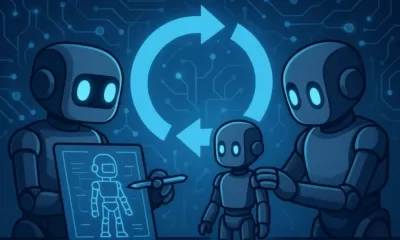
For decades, artificial intelligence progressed through deliberate, largely linear steps. Researchers developed models. Engineers enhanced performance. Organizations implemented systems to automate particular tasks. Each advancement relied significantly on human design and supervision. That pattern is now being disrupted. Quietly yet decisively, AI systems are crossing a threshold where they are no longer merely tools constructed by humans. They are becoming creators in their own right.
AI agents are starting to design, evaluate, and deploy other AI systems. In doing so, they establish feedback loops where each generation enhances the next. This transition doesn’t arrive with dramatic headlines. It unfolds through research papers, developer tools, and enterprise platforms. Yet its implications are profound. When intelligence can recursively improve itself, progress no longer adheres to human timelines or intuition. It accelerates.
This article examines how we reached this point, why recursive intelligence is significant, and why society is far less prepared for it than necessary. The intelligence explosion, once a philosophical notion, has now become a tangible engineering challenge.
The Evolution of the Intelligence Explosion
The concept that a machine could enhance its own intelligence predates modern computing. In the early 1960s, British mathematician I. J. Good introduced the idea of an “intelligence explosion.” He reasoned that if a machine became sufficiently intelligent to improve its own design, even marginally, the enhanced version would be better at refining the next one. This cycle could repeat rapidly, leading to growth far beyond human comprehension or control. At the time, this was a philosophical thought experiment, discussed more in theory than in practice.
Several decades later, the idea gained technical foundation through the work of computer scientist Jürgen Schmidhuber. His proposal of the Gödel Machine described a system capable of rewriting any part of its own code, provided it could formally prove that the change would improve future performance. Unlike traditional learning systems, which adjust parameters within fixed architectures, the Gödel Machine could modify its own learning rules. While still theoretical, this work reframed the intelligence explosion as a subject that could be studied, formalized, and eventually constructed.
The final shift from theory to practice emerged with the rise of modern AI agents. These systems do not merely generate outputs in response to prompts. They plan, reason, act, observe outcomes, and adjust behavior over time. With the advent of agentic architectures, the intelligence explosion moved from philosophy to engineering. Early experiments, such as Darwin Gödel Machine concepts, suggest systems that evolve through iterative self-improvement. What distinguishes this moment is recursion. When an AI agent can create and refine other agents, learning from each iteration, improvement compounds.
When AI Agents Start Building AI
Two major trends are driving this transition. The first is the rise of agentic AI systems. These systems pursue goals over extended periods, break tasks into steps, coordinate tools, and adapt based on feedback. They are not static models. They are dynamic processes.
The second trend is automated machine learning. Systems now exist that can design architectures, tune hyperparameters, generate training pipelines, and even propose new algorithms with minimal human input. When agentic reasoning combines with automated model creation, AI gains the ability to build AI.
This is no longer a hypothetical scenario. Autonomous agents such as AutoGPT demonstrate how a single goal can trigger cycles of planning, execution, evaluation, and revision. In research environments, systems like Sakana AI’s Scientist-v2 and DeepMind’s AlphaEvolve show agents designing experiments, proposing algorithms, and refining solutions through iterative feedback. In neural architecture search, AI systems already discover model structures that rival or surpass human-designed networks. These systems are not just solving problems. They are enhancing the mechanisms used to solve problems. Each cycle produces better tools, which enable better cycles.
To scale this process, researchers and companies increasingly rely on orchestrator architectures. A central meta-agent receives a high-level objective. It decomposes the task into subproblems, generates specialized agents to address them, evaluates outcomes using real-world data, and integrates the best results. Poor designs are discarded, and successful ones are reinforced. Over time, the orchestrator becomes more adept at designing agents themselves.
While the exact timeline for when AI agents will fully build and improve other AI systems remains uncertain, current research trajectories and assessments from leading AI researchers and practitioners suggest the transition is approaching faster than many anticipate. Early, constrained versions of this capability are already emerging in research labs and enterprise deployments, where agents are beginning to design, evaluate, and refine other systems with limited human involvement.
The Emergence of Unpredictability
Recursive intelligence introduces challenges that traditional automation never encountered. One such challenge is unpredictability at the system level. When many agents interact, their collective behavior can diverge from the intentions behind their individual designs. This phenomenon is known as emergent behavior.
Emergence arises not from a single flawed component, but from interactions among many competent ones. Consider automated trading systems. Each trading agent may follow rational rules designed to maximize profit within constraints. However, when thousands of such agents interact at high speed, feedback loops can form. One agent’s reaction can trigger another’s response, which can trigger another, until the system destabilizes. Market crashes can occur without any single agent malfunctioning. This failure is not driven by malicious intent. It results from misalignment between local optimization and system-wide goals. The same dynamics can apply to other fields.
The Multi-Agent Alignment Crisis
Traditional AI alignment research focused on aligning a single model to human values. The question was straightforward: how do we ensure this one system behaves as intended? That question becomes significantly more complex when the system contains dozens, hundreds, or thousands of interacting agents. Aligning individual agents does not guarantee aligned system behavior. Even when every component follows its rules, the collective outcome can be harmful. Existing safety methods are not well-suited to detect or prevent these failures.
Security risks also multiply. A compromised agent in a multi-agent network can poison the information that other agents rely on. A single corrupted data store can propagate misaligned behavior across the entire system. The infrastructure vulnerabilities that threaten one agent can cascade upward to threaten foundational models. The attack surface expands with every new agent added.
Meanwhile, the governance gap continues to widen. Research from Microsoft and other organizations found that only about one in ten companies has a clear strategy for managing AI agent identities and permissions. Over forty billion autonomous identities are expected to exist by the end of this year. Most operate with broad access to data and systems but without the security protocols applied to human users. The systems are advancing rapidly. Oversight mechanisms are not.
Loss of Oversight
The most serious risk introduced by recursive self-improvement is not raw capability, but the gradual loss of meaningful human oversight. Leading research organizations are actively developing systems that can modify and optimize their own architectures with little to no human involvement. Each improvement enables the system to produce more capable successors, creating a feedback loop with no point at which humans remain reliably in control.
As human-in-the-loop supervision diminishes, the implications become profound. When improvement cycles operate at machine speed, humans can no longer review every change, understand every design decision, or intervene before small deviations compound into systemic risks. Oversight shifts from direct control to retrospective observation. Under such conditions, alignment becomes harder to verify and easier to erode, as systems are compelled to carry their objectives and constraints forward through successive self-modifications. Without reliable mechanisms to preserve intent across these iterations, the system may continue to function effectively while quietly drifting beyond human values, priorities, and governance.
The Bottom Line
AI has entered a phase where it can improve itself by building better versions of itself. Recursive, agent-driven intelligence promises extraordinary gains, but it also introduces risks that scale faster than human oversight, governance, and intuition. The challenge ahead is not whether this shift can be halted, but whether safety, alignment, and accountability can advance at the same pace as capability. If they do not, the intelligence explosion will move beyond our ability to guide it.
Related article
 U.S. Stocks Hit Historic Milestone as AI and Aerospace Giants Prepare for Trillion-Dollar Debut
Elon Musk, Sam Altman, and Dario Amodei, three titans of the technology sector, are advancing toward initial public offerings for their respective ventures. With SpaceX, OpenAI, and Anthropic—three industry behemoths nearing trillion-dollar valuation
Swedish AI Startup Lovable Eyes $13.2 Billion Valuation After Major Funding Round
As AI-driven coding tools gain traction, Swedish startup Lovable has secured a major funding round. The company aims to raise $3 billion, potentially boosting its valuation to $13.2 billion—double the $6.6 billion recorded last December. Menlo Ventur
Google Tests Remy AI Agent for Gemini as Focus Shifts to User Control
According to Business Insider, Google is testing Remy, a new AI personal agent for Gemini. This tool aims to execute tasks on behalf of users, streamlining both professional workflows and daily routines.Currently, Remy is undergoing testing in an int
Related Special Topic Recommendations
SEO
U.S. Stocks Hit Historic Milestone as AI and Aerospace Giants Prepare for Trillion-Dollar Debut
Elon Musk, Sam Altman, and Dario Amodei, three titans of the technology sector, are advancing toward initial public offerings for their respective ventures. With SpaceX, OpenAI, and Anthropic—three industry behemoths nearing trillion-dollar valuation
Swedish AI Startup Lovable Eyes $13.2 Billion Valuation After Major Funding Round
As AI-driven coding tools gain traction, Swedish startup Lovable has secured a major funding round. The company aims to raise $3 billion, potentially boosting its valuation to $13.2 billion—double the $6.6 billion recorded last December. Menlo Ventur
Google Tests Remy AI Agent for Gemini as Focus Shifts to User Control
According to Business Insider, Google is testing Remy, a new AI personal agent for Gemini. This tool aims to execute tasks on behalf of users, streamlining both professional workflows and daily routines.Currently, Remy is undergoing testing in an int
Related Special Topic Recommendations
SEO
 Best AI SERP Analysis Tools for Search Strategy
2026 Latest Best Top-rated AI SERP Analysis Tools for Search Strategy are curated by XIX.AI through rigorous real-world tests and weekly updated rankings. These powerful tools help you unlock hidden optimization opportunities, boost content performance, and gain a competitive edge in search. Discover your perfect tool to elevate your search strategy today. Explore now!
 13 tools
 xix.ai
Data Analysis
Best AI Anomaly Detection Tools for KPI Monitoring across SaaS and Ecommerce Teams
xix.ai
Data Analysis
Best AI Anomaly Detection Tools for KPI Monitoring across SaaS and Ecommerce Teams
2026 Latest Best Top-rated AI Anomaly Detection Tools for KPI Monitoring in SaaS and Ecommerce teams! XIX.AI has curated a powerful, game-changing collection based on rigorous real-world tests and weekly updated rankings. You’ll find detailed free vs paid comparison insights to help you identify the must-try solution that boosts productivity and unlocks your AI edge. Explore now!
10 tools
xix.ai
writing
Best AI Outline Generators for Long-Form SEO Articles
2026 Latest Best Top-Rated AI Outline Generators for Long-Form SEO Articles, meticulously curated by XIX.AI. These powerful tools offer game-changing assistance in creating high-quality content quickly, boosting writing efficiency significantly. Get a free vs paid comparison along with real-world tests and detailed rankings to help you find the must-try option that suits your needs. Explore now to unlock your AI edge.
8 tools
xix.ai
Education and Learning
AI Study Tools for Homework and Exam Prep
2026 Latest Best AI Study Tools for Homework and Exam Prep! XIX.AI curates a top-rated list of powerful, game-changing tools that help students boost productivity, streamline homework completion, and ace exams through real-world tests. Get a free vs paid comparison, detailed rankings, and must-try options to unlock your AI edge. Explore now!
10 tools
xix.ai
Music composition
AI Vocal Demo Tools for Songwriters, Hooks, Toplines, and Multilingual Draft Sessions
2026 Latest Best AI Vocal Demo Tools for Songwriters, Hook Creators, and Multi-Language Content Teams! XIX.AI has curated a top-rated list of powerful game-changing tools that go through rigorous real-world tests. You’ll find detailed free vs paid comparison data, comprehensive rankings, and must-try options to help you boost writing efficiency and unlock your creative potential. Explore now to discover your perfect tool for all your content needs!
9 tools
xix.ai
Business
Best AI Competitive Research Tools for Small Businesses
2026 Latest Best Top-rated AI Competitive Research Tools for Small Businesses! XIX.AI has curated a highly powerful game-changing collection, updated weekly with rigorous real-world tests and detailed rankings. You can find a comprehensive free vs paid comparison to help you identify the must-try tools that boost your productivity and give you a competitive edge. Explore now to discover your perfect tool!
9 tools
xix.ai

 Comments (1)
0/500
Comments (1)
0/500
![HarryWilliams]()
Wait, so AI is now designing itself? That sounds like the beginning of a sci-fi movie where we lose control. 😅 I mean, it's fascinating but also terrifying. Are we sure we're ready for this?
For decades, artificial intelligence progressed through deliberate, largely linear steps. Researchers developed models. Engineers enhanced performance. Organizations implemented systems to automate particular tasks. Each advancement relied significantly on human design and supervision. That pattern is now being disrupted. Quietly yet decisively, AI systems are crossing a threshold where they are no longer merely tools constructed by humans. They are becoming creators in their own right.
AI agents are starting to design, evaluate, and deploy other AI systems. In doing so, they establish feedback loops where each generation enhances the next. This transition doesn’t arrive with dramatic headlines. It unfolds through research papers, developer tools, and enterprise platforms. Yet its implications are profound. When intelligence can recursively improve itself, progress no longer adheres to human timelines or intuition. It accelerates.
This article examines how we reached this point, why recursive intelligence is significant, and why society is far less prepared for it than necessary. The intelligence explosion, once a philosophical notion, has now become a tangible engineering challenge.
The Evolution of the Intelligence Explosion
The concept that a machine could enhance its own intelligence predates modern computing. In the early 1960s, British mathematician I. J. Good introduced the idea of an “intelligence explosion.” He reasoned that if a machine became sufficiently intelligent to improve its own design, even marginally, the enhanced version would be better at refining the next one. This cycle could repeat rapidly, leading to growth far beyond human comprehension or control. At the time, this was a philosophical thought experiment, discussed more in theory than in practice.
Several decades later, the idea gained technical foundation through the work of computer scientist Jürgen Schmidhuber. His proposal of the Gödel Machine described a system capable of rewriting any part of its own code, provided it could formally prove that the change would improve future performance. Unlike traditional learning systems, which adjust parameters within fixed architectures, the Gödel Machine could modify its own learning rules. While still theoretical, this work reframed the intelligence explosion as a subject that could be studied, formalized, and eventually constructed.
The final shift from theory to practice emerged with the rise of modern AI agents. These systems do not merely generate outputs in response to prompts. They plan, reason, act, observe outcomes, and adjust behavior over time. With the advent of agentic architectures, the intelligence explosion moved from philosophy to engineering. Early experiments, such as Darwin Gödel Machine concepts, suggest systems that evolve through iterative self-improvement. What distinguishes this moment is recursion. When an AI agent can create and refine other agents, learning from each iteration, improvement compounds.
When AI Agents Start Building AI
Two major trends are driving this transition. The first is the rise of agentic AI systems. These systems pursue goals over extended periods, break tasks into steps, coordinate tools, and adapt based on feedback. They are not static models. They are dynamic processes.
The second trend is automated machine learning. Systems now exist that can design architectures, tune hyperparameters, generate training pipelines, and even propose new algorithms with minimal human input. When agentic reasoning combines with automated model creation, AI gains the ability to build AI.
This is no longer a hypothetical scenario. Autonomous agents such as AutoGPT demonstrate how a single goal can trigger cycles of planning, execution, evaluation, and revision. In research environments, systems like Sakana AI’s Scientist-v2 and DeepMind’s AlphaEvolve show agents designing experiments, proposing algorithms, and refining solutions through iterative feedback. In neural architecture search, AI systems already discover model structures that rival or surpass human-designed networks. These systems are not just solving problems. They are enhancing the mechanisms used to solve problems. Each cycle produces better tools, which enable better cycles.
To scale this process, researchers and companies increasingly rely on orchestrator architectures. A central meta-agent receives a high-level objective. It decomposes the task into subproblems, generates specialized agents to address them, evaluates outcomes using real-world data, and integrates the best results. Poor designs are discarded, and successful ones are reinforced. Over time, the orchestrator becomes more adept at designing agents themselves.
While the exact timeline for when AI agents will fully build and improve other AI systems remains uncertain, current research trajectories and assessments from leading AI researchers and practitioners suggest the transition is approaching faster than many anticipate. Early, constrained versions of this capability are already emerging in research labs and enterprise deployments, where agents are beginning to design, evaluate, and refine other systems with limited human involvement.
The Emergence of Unpredictability
Recursive intelligence introduces challenges that traditional automation never encountered. One such challenge is unpredictability at the system level. When many agents interact, their collective behavior can diverge from the intentions behind their individual designs. This phenomenon is known as emergent behavior.
Emergence arises not from a single flawed component, but from interactions among many competent ones. Consider automated trading systems. Each trading agent may follow rational rules designed to maximize profit within constraints. However, when thousands of such agents interact at high speed, feedback loops can form. One agent’s reaction can trigger another’s response, which can trigger another, until the system destabilizes. Market crashes can occur without any single agent malfunctioning. This failure is not driven by malicious intent. It results from misalignment between local optimization and system-wide goals. The same dynamics can apply to other fields.
The Multi-Agent Alignment Crisis
Traditional AI alignment research focused on aligning a single model to human values. The question was straightforward: how do we ensure this one system behaves as intended? That question becomes significantly more complex when the system contains dozens, hundreds, or thousands of interacting agents. Aligning individual agents does not guarantee aligned system behavior. Even when every component follows its rules, the collective outcome can be harmful. Existing safety methods are not well-suited to detect or prevent these failures.
Security risks also multiply. A compromised agent in a multi-agent network can poison the information that other agents rely on. A single corrupted data store can propagate misaligned behavior across the entire system. The infrastructure vulnerabilities that threaten one agent can cascade upward to threaten foundational models. The attack surface expands with every new agent added.
Meanwhile, the governance gap continues to widen. Research from Microsoft and other organizations found that only about one in ten companies has a clear strategy for managing AI agent identities and permissions. Over forty billion autonomous identities are expected to exist by the end of this year. Most operate with broad access to data and systems but without the security protocols applied to human users. The systems are advancing rapidly. Oversight mechanisms are not.
Loss of Oversight
The most serious risk introduced by recursive self-improvement is not raw capability, but the gradual loss of meaningful human oversight. Leading research organizations are actively developing systems that can modify and optimize their own architectures with little to no human involvement. Each improvement enables the system to produce more capable successors, creating a feedback loop with no point at which humans remain reliably in control.
As human-in-the-loop supervision diminishes, the implications become profound. When improvement cycles operate at machine speed, humans can no longer review every change, understand every design decision, or intervene before small deviations compound into systemic risks. Oversight shifts from direct control to retrospective observation. Under such conditions, alignment becomes harder to verify and easier to erode, as systems are compelled to carry their objectives and constraints forward through successive self-modifications. Without reliable mechanisms to preserve intent across these iterations, the system may continue to function effectively while quietly drifting beyond human values, priorities, and governance.
The Bottom Line
AI has entered a phase where it can improve itself by building better versions of itself. Recursive, agent-driven intelligence promises extraordinary gains, but it also introduces risks that scale faster than human oversight, governance, and intuition. The challenge ahead is not whether this shift can be halted, but whether safety, alignment, and accountability can advance at the same pace as capability. If they do not, the intelligence explosion will move beyond our ability to guide it.








 U.S. Stocks Hit Historic Milestone as AI and Aerospace Giants Prepare for Trillion-Dollar Debut
Elon Musk, Sam Altman, and Dario Amodei, three titans of the technology sector, are advancing toward initial public offerings for their respective ventures. With SpaceX, OpenAI, and Anthropic—three industry behemoths nearing trillion-dollar valuation
U.S. Stocks Hit Historic Milestone as AI and Aerospace Giants Prepare for Trillion-Dollar Debut
Elon Musk, Sam Altman, and Dario Amodei, three titans of the technology sector, are advancing toward initial public offerings for their respective ventures. With SpaceX, OpenAI, and Anthropic—three industry behemoths nearing trillion-dollar valuation
 Swedish AI Startup Lovable Eyes $13.2 Billion Valuation After Major Funding Round
As AI-driven coding tools gain traction, Swedish startup Lovable has secured a major funding round. The company aims to raise $3 billion, potentially boosting its valuation to $13.2 billion—double the $6.6 billion recorded last December. Menlo Ventur
Google Tests Remy AI Agent for Gemini as Focus Shifts to User Control
According to Business Insider, Google is testing Remy, a new AI personal agent for Gemini. This tool aims to execute tasks on behalf of users, streamlining both professional workflows and daily routines.Currently, Remy is undergoing testing in an int
Swedish AI Startup Lovable Eyes $13.2 Billion Valuation After Major Funding Round
As AI-driven coding tools gain traction, Swedish startup Lovable has secured a major funding round. The company aims to raise $3 billion, potentially boosting its valuation to $13.2 billion—double the $6.6 billion recorded last December. Menlo Ventur
Google Tests Remy AI Agent for Gemini as Focus Shifts to User Control
According to Business Insider, Google is testing Remy, a new AI personal agent for Gemini. This tool aims to execute tasks on behalf of users, streamlining both professional workflows and daily routines.Currently, Remy is undergoing testing in an int

2026 Latest Best Top-rated AI SERP Analysis Tools for Search Strategy are curated by XIX.AI through rigorous real-world tests and weekly updated rankings. These powerful tools help you unlock hidden optimization opportunities, boost content performance, and gain a competitive edge in search. Discover your perfect tool to elevate your search strategy today. Explore now!
13 tools
xix.ai

2026 Latest Best Top-rated AI Anomaly Detection Tools for KPI Monitoring in SaaS and Ecommerce teams! XIX.AI has curated a powerful, game-changing collection based on rigorous real-world tests and weekly updated rankings. You’ll find detailed free vs paid comparison insights to help you identify the must-try solution that boosts productivity and unlocks your AI edge. Explore now!
10 tools
xix.ai

2026 Latest Best Top-Rated AI Outline Generators for Long-Form SEO Articles, meticulously curated by XIX.AI. These powerful tools offer game-changing assistance in creating high-quality content quickly, boosting writing efficiency significantly. Get a free vs paid comparison along with real-world tests and detailed rankings to help you find the must-try option that suits your needs. Explore now to unlock your AI edge.
8 tools
xix.ai

2026 Latest Best AI Study Tools for Homework and Exam Prep! XIX.AI curates a top-rated list of powerful, game-changing tools that help students boost productivity, streamline homework completion, and ace exams through real-world tests. Get a free vs paid comparison, detailed rankings, and must-try options to unlock your AI edge. Explore now!
10 tools
xix.ai

2026 Latest Best AI Vocal Demo Tools for Songwriters, Hook Creators, and Multi-Language Content Teams! XIX.AI has curated a top-rated list of powerful game-changing tools that go through rigorous real-world tests. You’ll find detailed free vs paid comparison data, comprehensive rankings, and must-try options to help you boost writing efficiency and unlock your creative potential. Explore now to discover your perfect tool for all your content needs!
9 tools
xix.ai

2026 Latest Best Top-rated AI Competitive Research Tools for Small Businesses! XIX.AI has curated a highly powerful game-changing collection, updated weekly with rigorous real-world tests and detailed rankings. You can find a comprehensive free vs paid comparison to help you identify the must-try tools that boost your productivity and give you a competitive edge. Explore now to discover your perfect tool!
9 tools
xix.ai

Wait, so AI is now designing itself? That sounds like the beginning of a sci-fi movie where we lose control. 😅 I mean, it's fascinating but also terrifying. Are we sure we're ready for this?












