


 Home
HomeTop Machine Learning Certifications for 2025: A Professional Guide
As artificial intelligence reshapes multiple industries, machine learning has become an essential discipline. Business leaders are increasingly required to understand AI’s strategic value, its practical business applications, and how to leverage data effectively.
Earning a machine learning certification can create significant career opportunities. Those interested in programming fundamentals are encouraged to explore our Python and TensorFlow courses.
Here’s a list of leading machine learning certifications:
1. MIT Sloan Artificial Intelligence: Implications for Business Strategy

Designed for senior leaders, this program features two instructors: Daniela Rus, the Andrew (1956) and Erna Viterbi Professor of Electrical Engineering and Computer Science and Director of MIT’s Computer Science and Artificial Intelligence Laboratory (CSAIL), and Thomas Malone, Professor of Information Technology and Organizational Studies at MIT Sloan. Malone is the author of Superminds (May 2018), holds 11 patents, and has been featured in Fortune, the New York Times, and Wired.
Graduates will gain:
- A solid understanding of AI and its practical business uses, enabling confident transformation into a forward-thinking organization.
- The capacity to guide strategic decisions and elevate performance by embedding AI-driven management insights.
- A dual perspective from MIT Sloan and MIT CSAIL, blending technological AI knowledge with strategic business vision.
2. Saïd Business School, University of Oxford AI Programme
This program helps professionals grasp AI's business potential and identify implementation opportunities.
Led by Matthias Holweg, an industrial engineer focused on process improvement, the curriculum covers:
- How to assess AI opportunities within your organization and create a compelling business case.
- A conceptual foundation in AI technologies—machine learning, deep learning, neural networks, and algorithms.
- Expert perspectives from Oxford Saïd faculty and industry leaders on AI’s social and ethical dimensions.
- Historical context of AI’s evolution to help forecast its future direction.
3. MIT Sloan Unsupervised Machine Learning: Unlocking the Potential of Data
This course focuses on using limited data to train AI models through unsupervised learning techniques.
Led by Antonio Torralba, Delta Electronics Professor at MIT EECS, participants explore representation learning, generative modeling, and interpretability in ML systems.
Key takeaways include:
- Methods to tackle business challenges with representation learning and improve AI project return on investment.
- Awareness of challenges and possibilities when deploying generative models.
- How to effectively use pre-trained models within an enterprise.
- The ability to create understandable and context-aware machine learning models.
4. LSE Machine Learning: Practical Applications
Advance your data proficiency and gain technical insight into the business uses of machine learning.
Learn how to structure a data strategy that works, apply regression techniques, and use tree-based and ensemble learning for accurate predictions. The course also introduces neural networks and their relevance in business.
You will:
- Master key machine learning approaches, including regression and ensemble methods.
- Write R code and implement ML techniques across data types.
- Explore advanced topics like neural networks and their commercial deployment.
- Receive a certificate from LSE, a globally recognized university in social sciences.
5. MIT Sloan Machine Learning in Business
Another offering from Daniela Rus and Thomas Malone, this program helps integrate machine learning into organizational strategy and execution.
Topics include ML's expanding role, data's importance, and creating implementation plans for sensor, language, and transactional data.
You’ll develop:
- A strategic roadmap for adopting machine learning in business operations.
- Technical ML awareness without requiring programming skills.
- Access to MIT faculty insights, potentially enhancing career prospects.
6. Cognilytica – Cognitive Project Management for AI (CPMAI) Certification
This extensive certification from Cognilytica covers data science and machine learning through the CPMAI framework, the recognized best practice for AI and ML initiatives.
Training includes:
- Foundations of AI and ML concepts.
- The Seven Patterns of AI.
- Best practices for managing AI projects.
- Detailed exploration of supervised, unsupervised, and reinforcement learning.
- Critical data science aspects for AI projects.
- Business and data comprehension, model development, and operationalization.
- Agile methodologies for AI development.
- Building ethical and responsible AI systems.
- Guidance for assembling an AI team.
Program features:
- Suitable for all skill levels.
- Six months to complete.
- 30-day access to materials post-completion.
- 30 hours of training.
10% Discount Code: unite-cogcourse-107. IBM Machine Learning Professional Certificate
Ideal for aspiring ML professionals, this six-course series covers essential algorithms and methods. Some Python, statistics, and linear algebra background is helpful.
Highlights:
- Six online courses.
- Covers unsupervised, supervised, deep, and reinforcement learning.
- Includes specialized topics like time series and survival analysis.
- Hands-on projects using open-source tools.
- IBM digital badge after completion.
- Approximately 6 months at 3 hours per week.
8. IBM AI Engineering Professional Certificate
This six-course credential prepares participants for roles as AI or ML engineers, covering core ML and deep learning concepts.
Key aspects:
- Supervised and unsupervised learning with Python.
- Use of ML libraries like Scikit-learn, Keras, PyTorch, and TensorFlow.
- Applications in computer vision, NLP, text analytics, and object recognition.
- IBM digital credential upon finishing.
- Estimated duration: 8 months, 3 hours/week.
9. Machine Learning by Stanford University
This broadly focused course by Stanford introduces key machine learning methods and their real-world applications.
You’ll learn:
- Supervised and unsupervised learning principles.
- Case studies in robotics, text understanding, medical informatics, and more.
- Receive a shareable certificate.
- Approximately 60 hours to complete.
10. Advanced Learning Algorithims
A concise yet thorough introduction to machine learning fundamentals, developed by DeepLearning.AI and Stanford Online.
Participants will:
- Gain insights from field experts.
- Build and train neural networks in TensorFlow for classification.
- Apply ML best practices for real-world generalization.
- Work with decision trees, random forests, and boosting methods.
- Complete the course in around 34 hours.
Related article
 How to fix Core Web Vitals for better SEO rankings
Streamline Report Card Comments with AI ToolsIntroductionAI Tools for Generating Report Card CommentsMagic SchoolAlmanac AIChat GPTUsing Magic School to Generate Report Card CommentsLogging into Magic SchoolSelecting the Report Card Comments ToolCust
Slackbot Becomes an AI Agent
Slackbot, the automated assistant embedded in Salesforce’s corporate messaging platform Slack, is evolving into an AI agent. Salesforce CTO Parker Harris envisions it achieving viral status comparable to OpenAI’s ChatGPT.The cloud software giant laun
ByteDance Boosts Core AI Incentives as Doubao Surges 14.6%
ByteDance recently convened a DouBao equity briefing to unveil fresh incentive policies for staff involved in the DouBao division. The strike price for DouBao shares has been lifted from $14.85 in June 2026 to $17.02, marking an approximate 14.6% inc
Related Special Topic Recommendations
Education and Learning
How to fix Core Web Vitals for better SEO rankings
Streamline Report Card Comments with AI ToolsIntroductionAI Tools for Generating Report Card CommentsMagic SchoolAlmanac AIChat GPTUsing Magic School to Generate Report Card CommentsLogging into Magic SchoolSelecting the Report Card Comments ToolCust
Slackbot Becomes an AI Agent
Slackbot, the automated assistant embedded in Salesforce’s corporate messaging platform Slack, is evolving into an AI agent. Salesforce CTO Parker Harris envisions it achieving viral status comparable to OpenAI’s ChatGPT.The cloud software giant laun
ByteDance Boosts Core AI Incentives as Doubao Surges 14.6%
ByteDance recently convened a DouBao equity briefing to unveil fresh incentive policies for staff involved in the DouBao division. The strike price for DouBao shares has been lifted from $14.85 in June 2026 to $17.02, marking an approximate 14.6% inc
Related Special Topic Recommendations
Education and Learning
 AI Study Tools for Homework and Exam Prep
2026 Latest Best AI Study Tools for Homework and Exam Prep! XIX.AI curates a top-rated list of powerful, game-changing tools that help students boost productivity, streamline homework completion, and ace exams through real-world tests. Get a free vs paid comparison, detailed rankings, and must-try options to unlock your AI edge. Explore now!
 10 tools
 xix.ai
Music composition
AI Vocal Demo Tools for Songwriters, Hooks, Toplines, and Multilingual Draft Sessions
xix.ai
Music composition
AI Vocal Demo Tools for Songwriters, Hooks, Toplines, and Multilingual Draft Sessions
2026 Latest Best AI Vocal Demo Tools for Songwriters, Hook Creators, and Multi-Language Content Teams! XIX.AI has curated a top-rated list of powerful game-changing tools that go through rigorous real-world tests. You’ll find detailed free vs paid comparison data, comprehensive rankings, and must-try options to help you boost writing efficiency and unlock your creative potential. Explore now to discover your perfect tool for all your content needs!
9 tools
xix.ai
Business
Best AI Competitive Research Tools for Small Businesses
2026 Latest Best Top-rated AI Competitive Research Tools for Small Businesses! XIX.AI has curated a highly powerful game-changing collection, updated weekly with rigorous real-world tests and detailed rankings. You can find a comprehensive free vs paid comparison to help you identify the must-try tools that boost your productivity and give you a competitive edge. Explore now to discover your perfect tool!
9 tools
xix.ai
Image editing
Photoshop AI Retouch Tools for Ecommerce Apparel, Skin Cleanup, and Color Consistency
2026 Latest Best Photoshop AI retouch tools for ecommerce apparel, skin cleanup, and color consistency! This top-rated curated list features powerful game-changing solutions that help you boost writing efficiency, streamline content creation, and achieve perfect visual results effortlessly. Each tool has undergone real-world tests through weekly updated rankings, complete with free vs paid comparison details. Backed by XIX.AI, it’s the must-try guide for anyone aiming to unlock your AI edge. Explore now!
10 tools
xix.ai
Prompt
Best AI Prompt Libraries for ChatGPT Workflows
2026 Latest Best Top-Rated AI Prompt Libraries for optimizing all types of ChatGPT workflows. XIX.AI has curated a powerful, game-changing collection that goes through rigorous real-world tests to ensure top performance. You can find detailed free vs paid comparisons and expert rankings to help you choose the must-try tools that boost your productivity and unlock your AI edge. Explore now!
11 tools
xix.ai
Education and Learning
AI Quiz Builder Platforms for Teachers, Tutors, and Cohort-Based Learning Programs
2026 Latest Best AI Quiz Builder Platforms for Teachers, Tutors, and Cohort-Based Learning Programs! XIX.AI has curated a top-rated list of powerful game-changing tools that go through real-world tests to deliver accurate rankings. These must-try platforms help boost writing efficiency, streamline content creation, and simplify quiz design across all learning scenarios. Explore now to discover your perfect tool for unlocking your AI edge in teaching!
13 tools
xix.ai

 Comments (0)
0/500
Comments (0)
0/500
As artificial intelligence reshapes multiple industries, machine learning has become an essential discipline. Business leaders are increasingly required to understand AI’s strategic value, its practical business applications, and how to leverage data effectively.
Earning a machine learning certification can create significant career opportunities. Those interested in programming fundamentals are encouraged to explore our Python and TensorFlow courses.
Here’s a list of leading machine learning certifications:
1. MIT Sloan Artificial Intelligence: Implications for Business Strategy
Designed for senior leaders, this program features two instructors: Daniela Rus, the Andrew (1956) and Erna Viterbi Professor of Electrical Engineering and Computer Science and Director of MIT’s Computer Science and Artificial Intelligence Laboratory (CSAIL), and Thomas Malone, Professor of Information Technology and Organizational Studies at MIT Sloan. Malone is the author of Superminds (May 2018), holds 11 patents, and has been featured in Fortune, the New York Times, and Wired.
Graduates will gain:
- A solid understanding of AI and its practical business uses, enabling confident transformation into a forward-thinking organization.
- The capacity to guide strategic decisions and elevate performance by embedding AI-driven management insights.
- A dual perspective from MIT Sloan and MIT CSAIL, blending technological AI knowledge with strategic business vision.
2. Saïd Business School, University of Oxford AI Programme
This program helps professionals grasp AI's business potential and identify implementation opportunities.
Led by Matthias Holweg, an industrial engineer focused on process improvement, the curriculum covers:
- How to assess AI opportunities within your organization and create a compelling business case.
- A conceptual foundation in AI technologies—machine learning, deep learning, neural networks, and algorithms.
- Expert perspectives from Oxford Saïd faculty and industry leaders on AI’s social and ethical dimensions.
- Historical context of AI’s evolution to help forecast its future direction.
3. MIT Sloan Unsupervised Machine Learning: Unlocking the Potential of Data
This course focuses on using limited data to train AI models through unsupervised learning techniques.
Led by Antonio Torralba, Delta Electronics Professor at MIT EECS, participants explore representation learning, generative modeling, and interpretability in ML systems.
Key takeaways include:
- Methods to tackle business challenges with representation learning and improve AI project return on investment.
- Awareness of challenges and possibilities when deploying generative models.
- How to effectively use pre-trained models within an enterprise.
- The ability to create understandable and context-aware machine learning models.
4. LSE Machine Learning: Practical Applications
Advance your data proficiency and gain technical insight into the business uses of machine learning.
Learn how to structure a data strategy that works, apply regression techniques, and use tree-based and ensemble learning for accurate predictions. The course also introduces neural networks and their relevance in business.
You will:
- Master key machine learning approaches, including regression and ensemble methods.
- Write R code and implement ML techniques across data types.
- Explore advanced topics like neural networks and their commercial deployment.
- Receive a certificate from LSE, a globally recognized university in social sciences.
5. MIT Sloan Machine Learning in Business
Another offering from Daniela Rus and Thomas Malone, this program helps integrate machine learning into organizational strategy and execution.
Topics include ML's expanding role, data's importance, and creating implementation plans for sensor, language, and transactional data.
You’ll develop:
- A strategic roadmap for adopting machine learning in business operations.
- Technical ML awareness without requiring programming skills.
- Access to MIT faculty insights, potentially enhancing career prospects.
6. Cognilytica – Cognitive Project Management for AI (CPMAI) Certification
This extensive certification from Cognilytica covers data science and machine learning through the CPMAI framework, the recognized best practice for AI and ML initiatives.
Training includes:
- Foundations of AI and ML concepts.
- The Seven Patterns of AI.
- Best practices for managing AI projects.
- Detailed exploration of supervised, unsupervised, and reinforcement learning.
- Critical data science aspects for AI projects.
- Business and data comprehension, model development, and operationalization.
- Agile methodologies for AI development.
- Building ethical and responsible AI systems.
- Guidance for assembling an AI team.
Program features:
- Suitable for all skill levels.
- Six months to complete.
- 30-day access to materials post-completion.
- 30 hours of training.
7. IBM Machine Learning Professional Certificate
Ideal for aspiring ML professionals, this six-course series covers essential algorithms and methods. Some Python, statistics, and linear algebra background is helpful.
Highlights:
- Six online courses.
- Covers unsupervised, supervised, deep, and reinforcement learning.
- Includes specialized topics like time series and survival analysis.
- Hands-on projects using open-source tools.
- IBM digital badge after completion.
- Approximately 6 months at 3 hours per week.
8. IBM AI Engineering Professional Certificate
This six-course credential prepares participants for roles as AI or ML engineers, covering core ML and deep learning concepts.
Key aspects:
- Supervised and unsupervised learning with Python.
- Use of ML libraries like Scikit-learn, Keras, PyTorch, and TensorFlow.
- Applications in computer vision, NLP, text analytics, and object recognition.
- IBM digital credential upon finishing.
- Estimated duration: 8 months, 3 hours/week.
9. Machine Learning by Stanford University
This broadly focused course by Stanford introduces key machine learning methods and their real-world applications.
You’ll learn:
- Supervised and unsupervised learning principles.
- Case studies in robotics, text understanding, medical informatics, and more.
- Receive a shareable certificate.
- Approximately 60 hours to complete.
10. Advanced Learning Algorithims
A concise yet thorough introduction to machine learning fundamentals, developed by DeepLearning.AI and Stanford Online.
Participants will:
- Gain insights from field experts.
- Build and train neural networks in TensorFlow for classification.
- Apply ML best practices for real-world generalization.
- Work with decision trees, random forests, and boosting methods.
- Complete the course in around 34 hours.








 How to fix Core Web Vitals for better SEO rankings
Streamline Report Card Comments with AI ToolsIntroductionAI Tools for Generating Report Card CommentsMagic SchoolAlmanac AIChat GPTUsing Magic School to Generate Report Card CommentsLogging into Magic SchoolSelecting the Report Card Comments ToolCust
How to fix Core Web Vitals for better SEO rankings
Streamline Report Card Comments with AI ToolsIntroductionAI Tools for Generating Report Card CommentsMagic SchoolAlmanac AIChat GPTUsing Magic School to Generate Report Card CommentsLogging into Magic SchoolSelecting the Report Card Comments ToolCust
 Slackbot Becomes an AI Agent
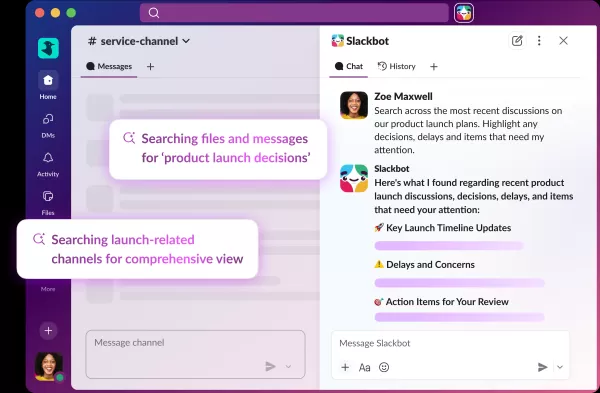
Slackbot, the automated assistant embedded in Salesforce’s corporate messaging platform Slack, is evolving into an AI agent. Salesforce CTO Parker Harris envisions it achieving viral status comparable to OpenAI’s ChatGPT.The cloud software giant laun
Slackbot Becomes an AI Agent
Slackbot, the automated assistant embedded in Salesforce’s corporate messaging platform Slack, is evolving into an AI agent. Salesforce CTO Parker Harris envisions it achieving viral status comparable to OpenAI’s ChatGPT.The cloud software giant laun
 ByteDance Boosts Core AI Incentives as Doubao Surges 14.6%
ByteDance recently convened a DouBao equity briefing to unveil fresh incentive policies for staff involved in the DouBao division. The strike price for DouBao shares has been lifted from $14.85 in June 2026 to $17.02, marking an approximate 14.6% inc
ByteDance Boosts Core AI Incentives as Doubao Surges 14.6%
ByteDance recently convened a DouBao equity briefing to unveil fresh incentive policies for staff involved in the DouBao division. The strike price for DouBao shares has been lifted from $14.85 in June 2026 to $17.02, marking an approximate 14.6% inc

2026 Latest Best AI Study Tools for Homework and Exam Prep! XIX.AI curates a top-rated list of powerful, game-changing tools that help students boost productivity, streamline homework completion, and ace exams through real-world tests. Get a free vs paid comparison, detailed rankings, and must-try options to unlock your AI edge. Explore now!
10 tools
xix.ai

2026 Latest Best AI Vocal Demo Tools for Songwriters, Hook Creators, and Multi-Language Content Teams! XIX.AI has curated a top-rated list of powerful game-changing tools that go through rigorous real-world tests. You’ll find detailed free vs paid comparison data, comprehensive rankings, and must-try options to help you boost writing efficiency and unlock your creative potential. Explore now to discover your perfect tool for all your content needs!
9 tools
xix.ai

2026 Latest Best Top-rated AI Competitive Research Tools for Small Businesses! XIX.AI has curated a highly powerful game-changing collection, updated weekly with rigorous real-world tests and detailed rankings. You can find a comprehensive free vs paid comparison to help you identify the must-try tools that boost your productivity and give you a competitive edge. Explore now to discover your perfect tool!
9 tools
xix.ai

2026 Latest Best Photoshop AI retouch tools for ecommerce apparel, skin cleanup, and color consistency! This top-rated curated list features powerful game-changing solutions that help you boost writing efficiency, streamline content creation, and achieve perfect visual results effortlessly. Each tool has undergone real-world tests through weekly updated rankings, complete with free vs paid comparison details. Backed by XIX.AI, it’s the must-try guide for anyone aiming to unlock your AI edge. Explore now!
10 tools
xix.ai
2026 Latest Best Top-Rated AI Prompt Libraries for optimizing all types of ChatGPT workflows. XIX.AI has curated a powerful, game-changing collection that goes through rigorous real-world tests to ensure top performance. You can find detailed free vs paid comparisons and expert rankings to help you choose the must-try tools that boost your productivity and unlock your AI edge. Explore now!
11 tools
xix.ai

2026 Latest Best AI Quiz Builder Platforms for Teachers, Tutors, and Cohort-Based Learning Programs! XIX.AI has curated a top-rated list of powerful game-changing tools that go through real-world tests to deliver accurate rankings. These must-try platforms help boost writing efficiency, streamline content creation, and simplify quiz design across all learning scenarios. Explore now to discover your perfect tool for unlocking your AI edge in teaching!
13 tools
xix.ai












