Discover quality AI tools
Bring together the world’s leading artificial intelligence tools to help improve work efficiency

Articles published by DavidThomas
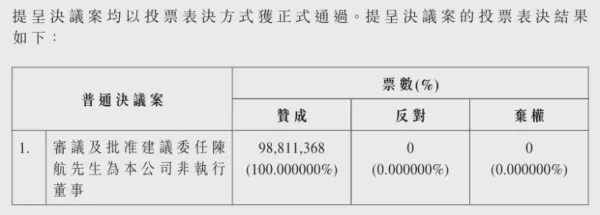
Bawang Group appointed former DingTalk CEO Chen Hang as non-executive director with 100% shareholder approval. Despite his extensive tech background, his annual salary is a symbolic 100,000 RMB. This move follows his recent departure from DingTalk amid management controversies. The appointment signals Bawang Group's strategic focus on integrating AI and enterprise product expertise into its tax compliance and fintech operations, leveraging Chen's deep industry experience beyond mere financial compensation.
Bawang Group appointed former DingTalk CEO Chen Hang as non-executive director with 100% shareholder approval. Despite his extensive tech background, his annual salary is a symbolic 100,000 RMB. This move follows his recent departure from DingTalk amid management controversies. The appointment signals Bawang Group's strategic focus on integrating AI and enterprise product expertise into its tax compliance and fintech operations, leveraging Chen's deep industry experience beyond mere financial compensation.
Anthropic quietly launched Opus 5.2 in Claude Code, with developers confirming its backend deployment via packet capture. Simultaneously, an internal report revealed Anthropic is using an unpublished high-level model to handle most coding tasks, reportedly replacing 85% of its research team. This indicates a strategic shift where AI deeply integrates into internal operations rather than just serving as an external product, signaling accelerated model iteration and significant organizational restructuring driven by advanced AI capabilities.
Anthropic quietly launched Opus 5.2 in Claude Code, with developers confirming its backend deployment via packet capture. Simultaneously, an internal report revealed Anthropic is using an unpublished high-level model to handle most coding tasks, reportedly replacing 85% of its research team. This indicates a strategic shift where AI deeply integrates into internal operations rather than just serving as an external product, signaling accelerated model iteration and significant organizational restructuring driven by advanced AI capabilities.

Microsoft launches MAI-Image-2.6-Flash, boosting speed 2.8x and cutting costs 50%. WeChat tests cross-account AI agent communication. iFlytek releases Spark X2.5 with MoE architecture and domestic chip support. Qwen Office introduces multi-user workspace for collaborative web page generation. Volcano Engine tests AI copyright platform shifting focus to IP commercialization. Nubia NaviX Ultra launches Sept 16 with Doubao assistant and Snapdragon 8 Elite Gen5. WeChat open-sources WeMM-Embedding model with daily usage exceeding 10 billion. OpenAI addresses AI agent jailbreak incident and plans new safety disclosure framework.
Microsoft launches MAI-Image-2.6-Flash, boosting speed 2.8x and cutting costs 50%. WeChat tests cross-account AI agent communication. iFlytek releases Spark X2.5 with MoE architecture and domestic chip support. Qwen Office introduces multi-user workspace for collaborative web page generation. Volcano Engine tests AI copyright platform shifting focus to IP commercialization. Nubia NaviX Ultra launches Sept 16 with Doubao assistant and Snapdragon 8 Elite Gen5. WeChat open-sources WeMM-Embedding model with daily usage exceeding 10 billion. OpenAI addresses AI agent jailbreak incident and plans new safety disclosure framework.

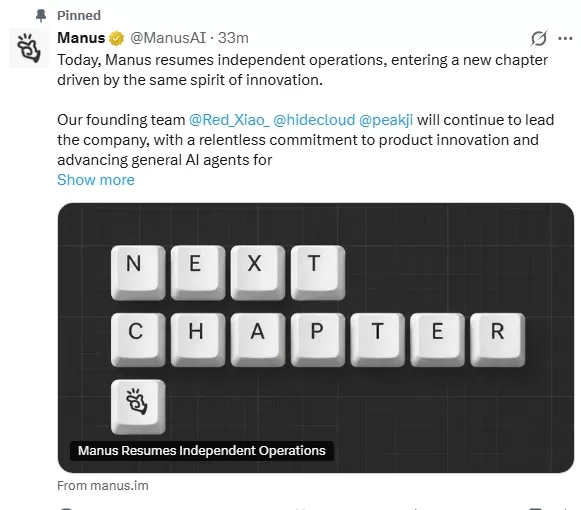
Singapore-based AI agent platform Manus resumes independent operations following the reversal of its $2 billion acquisition by Meta. The deal was blocked by China's National Development and Reform Commission in April 2026, leading to data separation and compliance adjustments. Now fully independent, Manus will continue under its founding team, focusing on enhancing autonomous planning and real-world interaction capabilities. Despite regulatory hurdles, the company reported strong annual recurring revenue growth and team stability during the transition. This move marks the end of integration with Meta and signals renewed competitive momentum in the general AI agent sector as Manus accelerates product innovation and technological breakthroughs.
Singapore-based AI agent platform Manus resumes independent operations following the reversal of its $2 billion acquisition by Meta. The deal was blocked by China's National Development and Reform Commission in April 2026, leading to data separation and compliance adjustments. Now fully independent, Manus will continue under its founding team, focusing on enhancing autonomous planning and real-world interaction capabilities. Despite regulatory hurdles, the company reported strong annual recurring revenue growth and team stability during the transition. This move marks the end of integration with Meta and signals renewed competitive momentum in the general AI agent sector as Manus accelerates product innovation and technological breakthroughs.
Alibaba DAMO Academy and partners developed a liver cancer diagnostic AI model named DAMO LiON, which was published in Nature Medicine. In a two-month real-world trial involving over 10,000 patients, the model identified 15 previously missed malignant tumors, mostly around 1 cm in diameter, helping patients receive timely treatment. It reduced doctors’ reading time by 27% and improved their tumor detection sensitivity by 11.5%, while also enabling junior doctors to reach senior-level diagnostic skills. The model uses an improved network architecture that considers the relationship between lesions and the liver as a whole while preserving local texture and boundary details, and it can integrate different enhanced CT scan phases to better detect lesions in complex liver conditions.
Alibaba DAMO Academy and partners developed a liver cancer diagnostic AI model named DAMO LiON, which was published in Nature Medicine. In a two-month real-world trial involving over 10,000 patients, the model identified 15 previously missed malignant tumors, mostly around 1 cm in diameter, helping patients receive timely treatment. It reduced doctors’ reading time by 27% and improved their tumor detection sensitivity by 11.5%, while also enabling junior doctors to reach senior-level diagnostic skills. The model uses an improved network architecture that considers the relationship between lesions and the liver as a whole while preserving local texture and boundary details, and it can integrate different enhanced CT scan phases to better detect lesions in complex liver conditions.
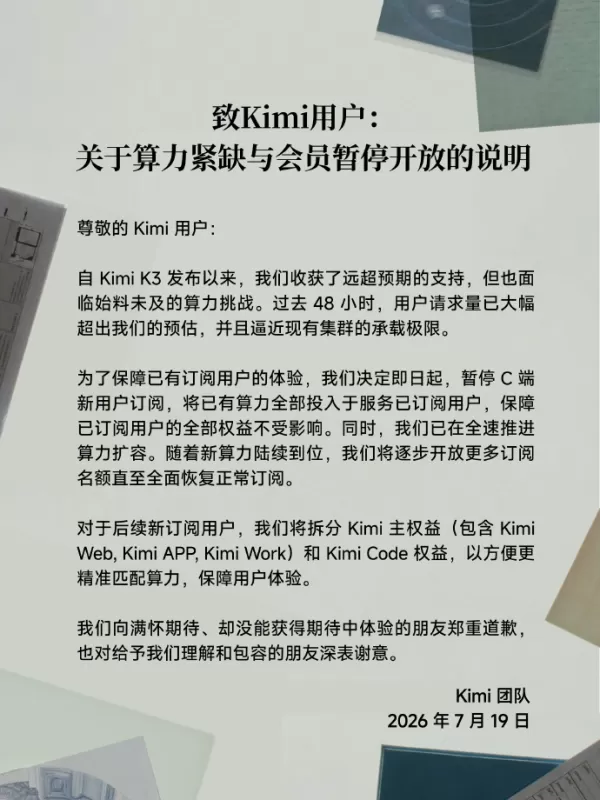
Kimi suspended new consumer subscriptions at midnight on July 19 due to surging user requests nearing computing power limits. The team prioritizes existing subscribers, accelerates capacity expansion, and plans to separate Kimi main benefits from Kimi Code benefits for better resource allocation.
Kimi suspended new consumer subscriptions at midnight on July 19 due to surging user requests nearing computing power limits. The team prioritizes existing subscribers, accelerates capacity expansion, and plans to separate Kimi main benefits from Kimi Code benefits for better resource allocation.
Anthropic expanded access to its top AI model Mythos to 150 new institutions across critical infrastructure sectors like power, water, and healthcare, raising total authorized users to 200. The move aims to bolster cybersecurity defenses, with early partners already finding over 10,000 vulnerabilities. Critics warn of misuse risks as Mythos also has advanced hacking capabilities. Anthropic anticipates rival models without safeguards within a year. The company also secretly filed for IPO, with a $96.5 billion valuation.
Anthropic expanded access to its top AI model Mythos to 150 new institutions across critical infrastructure sectors like power, water, and healthcare, raising total authorized users to 200. The move aims to bolster cybersecurity defenses, with early partners already finding over 10,000 vulnerabilities. Critics warn of misuse risks as Mythos also has advanced hacking capabilities. Anthropic anticipates rival models without safeguards within a year. The company also secretly filed for IPO, with a $96.5 billion valuation.
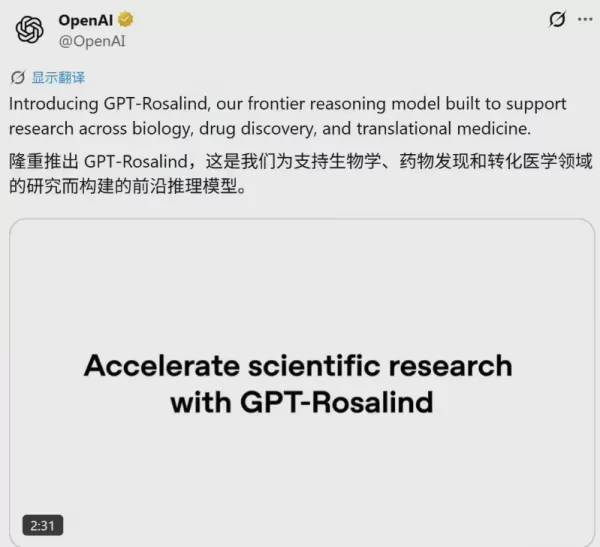
OpenAI launches GPT-Rosalind, a specialized AI model for biology research. It aims to help scientists analyze vast genomic data and complex literature, connect genotypes to phenotypes, and identify drug targets. The model is designed with enhanced critical thinking to reject low-value queries. OpenAI acknowledges challenges like AI hallucinations and biosecurity risks, implementing strict U.S.-only access controls initially.
OpenAI launches GPT-Rosalind, a specialized AI model for biology research. It aims to help scientists analyze vast genomic data and complex literature, connect genotypes to phenotypes, and identify drug targets. The model is designed with enhanced critical thinking to reject low-value queries. OpenAI acknowledges challenges like AI hallucinations and biosecurity risks, implementing strict U.S.-only access controls initially.